

How the Best Teams Decide: Architecture Over Argument
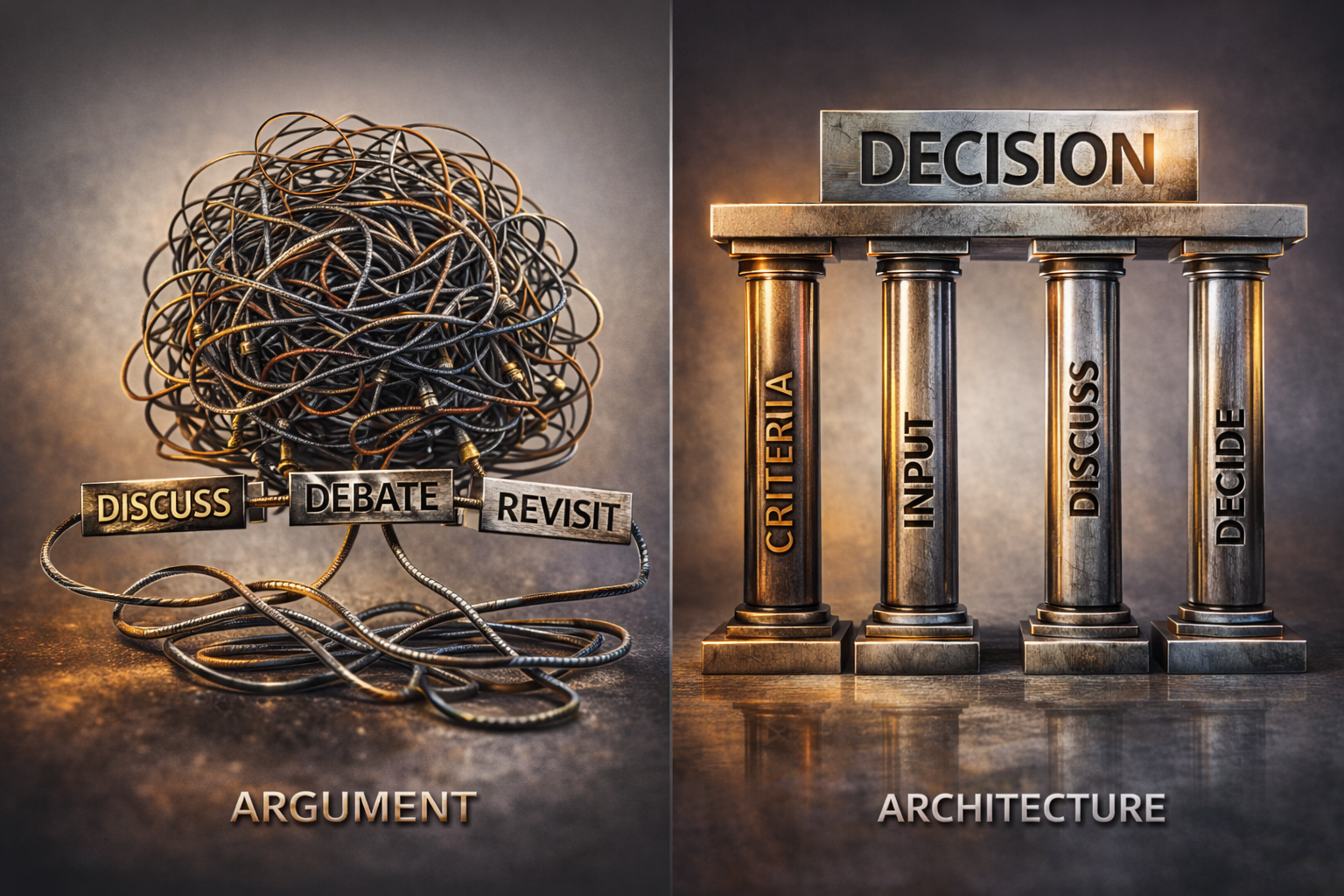
In my last piece, I argued that insight isn’t enough. Execution is behavioral. It requires explicit priorities, visible ownership, and disciplined follow-through.
But here’s what sits upstream of execution:
Decision design.
Most stalled execution is not a motivation problem. It’s not even an accountability problem. It’s a decision architecture problem.
Leadership teams often believe they struggle because of disagreement. They don’t. Healthy disagreement is oxygen. The real issue is what happens around the disagreement. Who ultimately decides? What qualifies as sufficient data? When does debate end? What does commitment mean if you didn’t get your way?
Without clarity on those questions, teams substitute argument for architecture.
And argument scales poorly.
High-performing teams treat decisions as a system, not an event. They are explicit about:
Decision rights — Who decides? Who inputs? Who must be consulted?
Decision criteria — What does “good enough” look like before we begin debating?
Time boundaries — When does exploration close and commitment begin?
Commitment norms — Are we aligning, or are we agreeing?
Many teams confuse consensus with commitment. They believe everyone must fully agree before moving forward. The result? Endless revisiting. Side conversations. Quiet resistance. Fragile execution.
The best teams understand a harder truth: commitment does not require agreement. It requires clarity and trust.
Architecture makes that possible.
When decision rights are unambiguous, debate becomes sharper and less personal. When criteria are defined in advance, data becomes a tool rather than a weapon. When time boundaries are respected, momentum builds. When commitment norms are explicit, execution stabilizes.
This is not bureaucratic overhead. It is how teams build trust and clarity into their day-to-day work.
Execution, as I wrote previously, is where strategy becomes real. But execution cannot outperform the decisions that precede it. If decisions are murky, execution will wobble. If decisions are constantly reopened, accountability dissolves.
Smart teams don’t win because they argue better. They win because they design how they decide.
Where in your team are decisions clear in conversation but ambiguous in structure? What would change if you built architecture instead of relying on argument?
